
get a mortgage from the option market
the growing way rich people get cash
I sold a house in the DFW area in 2022. Instead of a mortgage, the buyers financed the purchase via a margin loan against their stock holdings held in a Morgan Stanley account. A bit unusual. That was the year mortgage rates spiked so maybe the margin rate looked relatively more palatable. But there could be other reasons too. For example, getting a loan or HELOC is much harder these days without a fat W2 income, so maybe the buyer was an entrepreneur or retiree.
[I remember the aftermath of the credit crunch, an oil option trader I knew just had an 8-figure year as an independent trader, couldn’t borrow even $2mm of the $5mm loft he bought because his income was deemed so variable. I’m not saying bankers should use a sortino ratio, but damn that was broken. The contrast of today, when every risk gets underwritten with little premium, to that era when banks wouldn’t touch cash-good risks is stark. Do what you want with that.]
We are going to start construction on an ADU so I’ve been thinking about financing at a time when there are more options (a pun that doubles as foreshadowing). Last week, I wrote a guide to option margin. While a post like that was overdue, the timing of it was not an accident. It is deeply entwined with today’s topic of disintermediated borrowing.
Box Spreads Go Mainstream
If you’re here, you probably know a box spread is a way to borrow or lend cash via the options market. A quick refresher from the lender’s point of view:
It’s a very vanilla option trade where you buy a synthetic long at one strike, sell a synthetic short at another strike, same expiration, and you’re left with a position whose terminal payoff is just the difference between the two strikes. Since you are both long and short the underlying for a known differential at expiry, that’s a profit guaranteed in the future. That future profit trades at a discount today because of the time value of money.
Since the profit is guaranteed, the discount rate is approximately the risk-free rate. In other words, it looks like a bond. You might pay $9.60 today for a riskless $10 in one year. In this case, you are lending $9.70 to the options market. The credit risk is minimal because, just like any option trade, you are facing the Options Clearing Corporation (OCC), not a counterparty or brokerage.
You can find a fuller treatment of mechanics in my post BOXX: Access Options Funding Rates In An ETF. BOXX was born around the time I wrote that article. Today, there is over $10B of assets in BOXX (I own some as well). Its success has had a ripple effect for consumers, creating an entire new financing market that is cutting out high-overhead banks by leveraging 2 innovations that are sadly not often recognized as innovations unless you work in finance:
- better risk-management
- liquidity
We jeered when the head of a vampire squid said he was doing god’s work, but Lloyd was being both cheeky and observant at the same time. But I agree, it’s hard to concede credit to a band of traders who somehow got made whole on their CDS while everyone else was forced to take medicine after the credit crisis. (This felt like Epstein class cronyism between gov’t and private industry revolving doors even before the unaccountability of elites became the issue it is today. In fact, that period felt like it got the ball rolling not to mention spread the ashes from which BTC would emerge. My crank sense of recent history is that the GFC is probably still underrated as far as what it did to any sense that we animals are created equal. Private gains with socialized losses probably revealed a US class system that hid for a long time behind a shared story. So long to that fairy tale. The spirit of the day is more like picking through the salvage bins for your own family’s needs while you watch the elites loot the trust that dies hardest because it’s rooted in desperate hope. Oops, that got out of hand fast.
Where were we? Ahh, yes, risk management and liquidity. The risk management part comes from the portfolio margin framework adopted by exchanges for margin accounts that opt into it. It’s explained in last week’s post, but it’s ultimately about looking at portfolios holistically and allowing for sensible offsets for analogous instruments. A call spread is a combination of 2 options, but the risk is well-defined if you recognize them as a single chunk. Asking for reserves that exceed the maximum loss is inefficient. Which means we can make the world more efficient by measuring better. I think we have enough computers to do that in 2026. Low-hanging fruit.
It’s hard to appreciate productivity gains like this because it’s not visible in the same consumer-friendly way as a phone with a camera in it. This goes for liquidity as well. If the inputs to pricing any risk become more transparent and measurable, then someone will require less premium to underwrite the risk. Pricing gets tighter, attracts more volume, more transparency and a virtuous loop repeats. It’s the gist of not needing to come to terms with finance guilt.
[As financial innovation goes, I’m not sure if the last PhD hired to provide best-in-class liquidity services has low societal ROI but the first one has a high one, and we can’t really know the limits. As freedom and competition go, the argument is best reserved for dorm rooms smoke-outs instead of pre-policy dossiers with a red hammer on the cover.]
Anyway, once a giant “lender” like BOXX pokes its beak in the options market, it attracts borrowers. Liquidity begets liquidity. For decades, box spreads have been a quiet financing tool for market makers and hedge funds operating under intelligent margin frameworks. They are now shaping a two-sided retail banking function. Without the banks.
The emergence of a retail box market
In early 2024, just months after BOXX launched the average daily notional volume on SPX box spreads was over $900 million. A year later, it had grown by 30% to over $1.2B. The CBOE has built an entire suite around the popularization of box spreads.
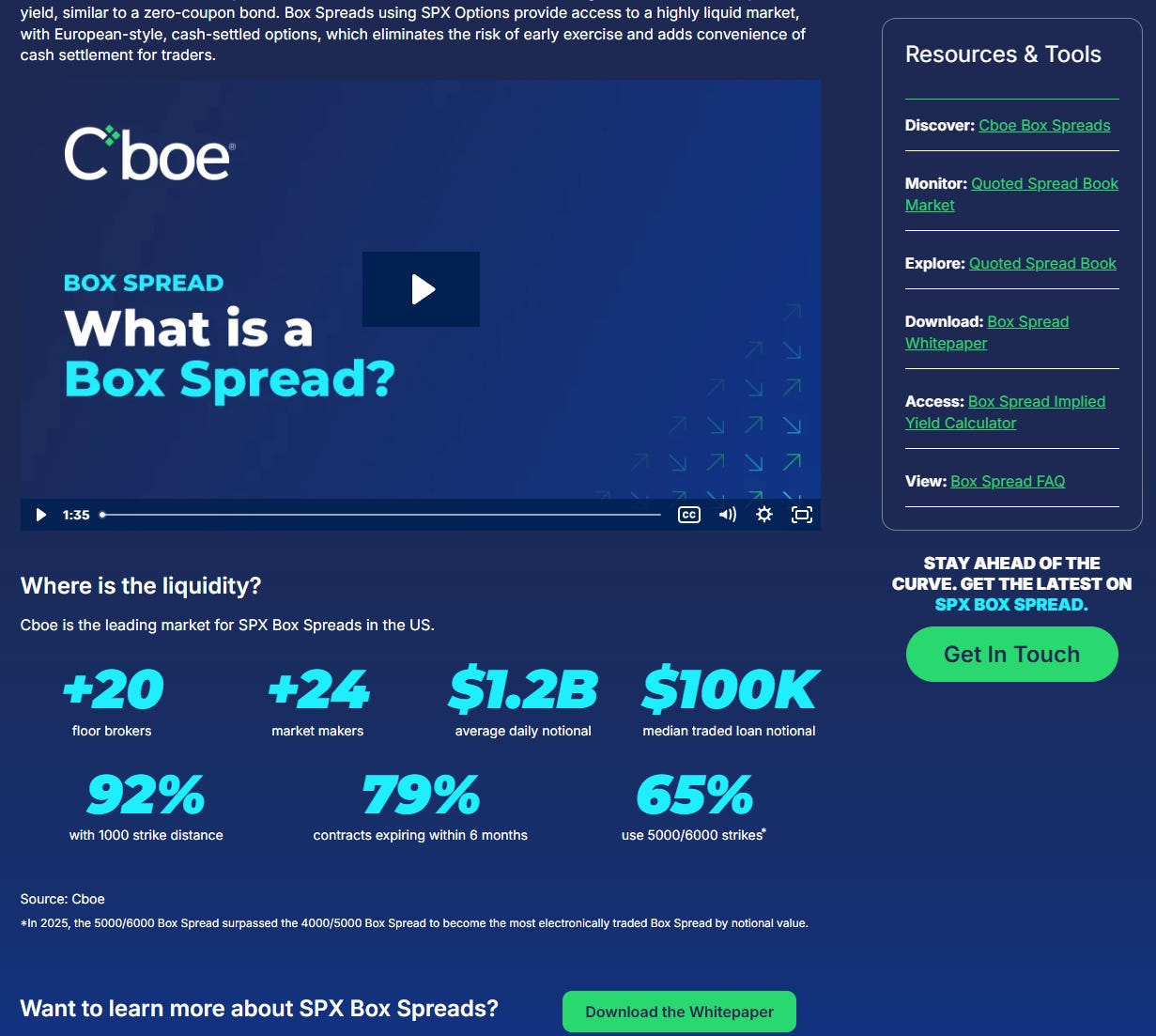
In addition to all the education (these are options after all), they’ve greased access to the box market via the Quoted Spread Book, launched June 2024. Cboe calls it QSB; I’ve always heard it as the “COB” or complex order book, which is the general way to interact with package orders in SPX.
Before QSB, market makers were not allowed to rest orders in SPX option COBs during regular hours forcing boxes and other complex orders to trade open outcry in the pit. Chicago is a gangsta town son. This effectively gated the market to those with a broker. Now, MMs can post electronic quotes in designated box spreads, box swaps and jelly rolls (calendar spreads of boxes used to roll from one expiry to another).
Each trading day CBOE designates roughly 10 box spreads and 25 box swaps as quotable with strikes in 1000-point increments. Since the option multiplier is 100, a 1 lot box spread corresponds to $100k value at expiration. You can think of that as the standard face value of the “bond”. A 10-lot would correspond to $1mm.
The borrower side of the trade
Pre-existing market participants create both the supply and demand for spreads in response to their cash management needs while BOXX is a structural buyer of boxes (a lending transaction) so long as it enjoys inflows.
The market is now seeing a new breed of borrower via sellers of box spreads. Historically, that borrower was a dealer financing options inventory. Increasingly, it is a wealthy household financing a house, a tax bill, or consumption. Given the endless bull run of equity markets, being wealthy almost certainly means sitting on a pile of unrealized capital gains. The economic impact of deferring or ultimately avoiding taxes is likely an order of magnitude higher than earning more market alpha. Eeking out an extra 200 bps of return per unit of risk is just not that interesting if you have to pay taxes on it every year, especially if you live in CA, NY, or Chicago, where somewhat ironically many alpha-obsessives tend to gather (notwithstanding large recent migrations to FL, TX, NV, and of course PR).
The reluctance to realize capital gains is the root of the “buy, borrow, die” strategy which revolves around funding expenditures with loans against appreciating collateral. Then, at death, the cost basis of the assets is stepped up to current market value when heirs can sell to pay off the loans. Rajiv Rebello’s Eliminating a Large Capital Gain with Tax-Aware Investing explains this as well as other increasingly popular tax alpha strategies. The common theme running through them is the use of borrowing/leverage to delay the tax man, hopefully forever.
Box spreads allow consumers with a healthy asset buffer to borrow at highly attractive rates, especially on an after-tax basis. Box rates typically print within 50 bps or less of treasuries of comparable duration. The “interest” you pay is realized as a Section 1256 capital loss, marked to market each year, 60% long-term and 40% short-term. Meanwhile, a margin loan at Schwab or a securities-backed line at a wirehouse can easily spread 200–400 bps over government rates. Depending on your personal itemization situation, the interest on those loans may be non-deductible.
The catch, of course, is that “all you have to do” to capture this is correctly execute a four-legged SPX option spread on an order book, understand margin against your portfolio, and roll spread before expiry. This is enough to keep most affluent households away, but this is changing.
White-glove vs. DIY
There are now broadly two paths.
White-glove
A handful of providers will run the strategy for you or for your advisor.
- SyntheticFi is the most aggressive on the retail and RIA side — YC-backed, run by Joseph Wang (ex-Deutsche Bank rates, ex-VRGL). SyntheticFI pitches itself as a sub-advisor that integrates with your existing brokerage rather than asking you to move assets. They handle execution and rolls and charge somewhere in the neighborhood of 50 bps on the borrowed amount
- Vest’s Synthetic Borrow is on Schwab’s Managed Accounts Marketplace and runs at roughly 95 bps. Managed box spread financing, advisor-distributed.
- Aptus is an asset manager with both option-based ETF offerings and an option overlay program which now includes box spread financing.
I’m not endorsing any of these but as I’ve seen box spreads awareness grow these commercial programs have made their way into my feeds.
DIY
As I alluded to earlier, if you have a portfolio margin account and feel comfortable executing option packages, you can do this yourself. You can even piggyback on SyntheticFI’s marketing efforts by using boxtrades.com (whose order book data is aggregated via SyntheticFi) to see daily and historical prints and rates by expiration.
The DIY route will save you 50–100 bps in fees in exchange for needing to handle the operations of trading, rolling and monitoring margin.
If you are interested in this route, I vibed up a handy checklist:
🔗Box Spread Borrowing: The Compact Guide
Home-financing angles
CBOE leads with this base scenario:
Instead of a 7% mortgages, borrow at the 5-year box rate of 4.5%. The “interest” on the box accrues annually as a 1256 capital loss, which you can use to offset gains elsewhere in the portfolio. A high-bracket household is financing a house at something with a 3-handle on it. From there, you can stack by taking a conforming or jumbo first mortgage up to the deductible-interest cap, then box-finance the rest.
Additional risk and other considerations
- The “jingle mail” option. A mortgage does have some unique advantages. It is a non-recourse loan.
- Margin call risk. Your portfolio is collateral. If SPX drops 30% the day after you buy the house, you may need to add cash, sell something, or roll into a smaller box. SyntheticFi’s published worked example has a borrower at 42% LTV able to absorb a ~40% portfolio drawdown before margin call. You are short a tail. Of course, you could also buy tails to cap your margin risk!
- Asset-liability mismatch. The box has a fixed maturity that is likely shorter than the duration of homeownership. You will need to roll, and the next box will print at whatever the curve is at that point. You have similar rate risks as an adjustable rate mortgage.
- Interest-rate risk on early unwind. If you need to close the box before expiration, you mark to current rates, which can be a cost.
- Realized interest costs. A simple rolling example could mean selling a new 1-year box for 96% of new face to buy back an old box at ~99% of face with 2 months left. The net out-of-pocket of 3% of face is your realized interest.
my little baby is all grown up
Before I go on, I just want to acknowledge how weird it feels to see box spreads become something a normal investor might hear about. When I was a trainee, the first option structures they taught were financing trades:
- synthetic futures (or combos in the parlance of our time)
- reversals and conversions which are just synthetic futures with an offsetting stock position
- box spreads which are just spreads of synthetic futures (later you learn that algebraically they are equivalent to the sum of the call spread and the put spreads between the 2 strikes, an identity which helps you make markets in mock trading much faster!)
Despite some latent pangs of “I liked that band before you even heard of them”, the mainstreaming of box spreads makes a ton of sense.
Lending markets are normally intermediated by banks. The bank takes deposits at one rate and lends them out at a higher rate; the spread is the bank’s margin and the cost of the bank’s existence. The box spread goes around a costly bilateral transaction to let two market participants, one with cash, one with collateral, meet on a regulated exchange and swap exposures at clearinghouse-guaranteed rate.
Wes Gray, who co-created BOXX, told Brent Sullivan in Tax Alpha Insider:
Box spreads might be the ultimate ‘disintermediated’ borrowing mechanism out there.
The CBOE, fintech, and advisor community have found enough forgone bank margin to insert themselves as brokers between consumer borrowers and the liquid funding market entwined in the booming options business.
The wholesale financing rate that has historically been available to a market maker on the SPX floor is now accessible to a household with $2M in a brokerage account. These same households that are sitting on appreciated assets, which they can conveniently sell slowly in a tax-efficient way as the gains wash with the capital losses on the box “interest”.
Financial innovation and competition is notably triumphant in solving high-class problems. You can decide how to feel about that but I gotta figure out how to finance this ADU so you get to learn about stuff like this.
Further reading
- $1 Trillion Box-Spread AUM Is Up For Grabs (Brent Sullivan, Tax Alpha Insider)
- Long-Dated Box Spreads: A Better Way to Buy a Home (SyntheticFI via CBOE)
- How to Borrow at Rates Below 4% AND with Tax Benefits (30/40 Wealth)
- SPX Box Spreads: What Every Advisor Should Know (CBOE with Joe DeSipio at Arin, the ex-SIG team that sub-advises BOXX)
- Quoted Spread Book (Cboe market-structure docs)