
face-ripper
flows before prose
If you reside in the quark-sized intersection of people who read this letter but don’t follow the market, I’m informing you that shares of corporations are up sharply in the past 5 weeks.
This is obviously cherry picking, but from March 30th to today the S&P has a sharpe ratio north of 10 and QQQ is above 12 lol
— cephalopodshop (@macrocephalopod) May 6, 2026
The magnitude and speed of the rally have been “hellacious” to use a mentor’s favorite way to describe the face-ripping bear market rallies. Not that this is a bear market rally. As you know, bears are extinct and all the degeneracy you see is their normal diet flourishing without a natural predator.
Now, about that face-ripper…my turn to cherry-pick. It turns out selling calls that carry a high implied vol but were in the 0th percentile of skew wasn’t really “income”.
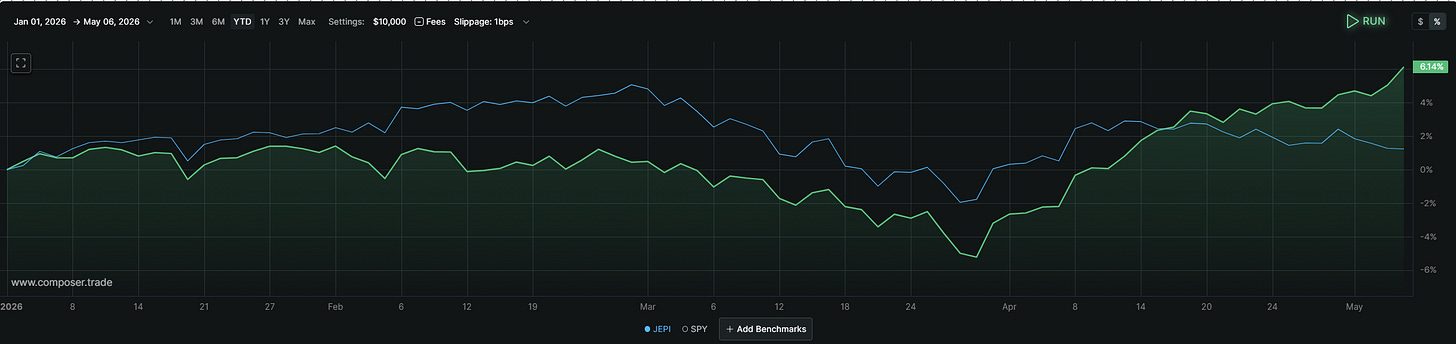
The green line is a portfolio of 75% SPY, 25% cash rebalanced monthly which is a more proper comparison to JEPI which sells OTM calls. Rough month for the home team.
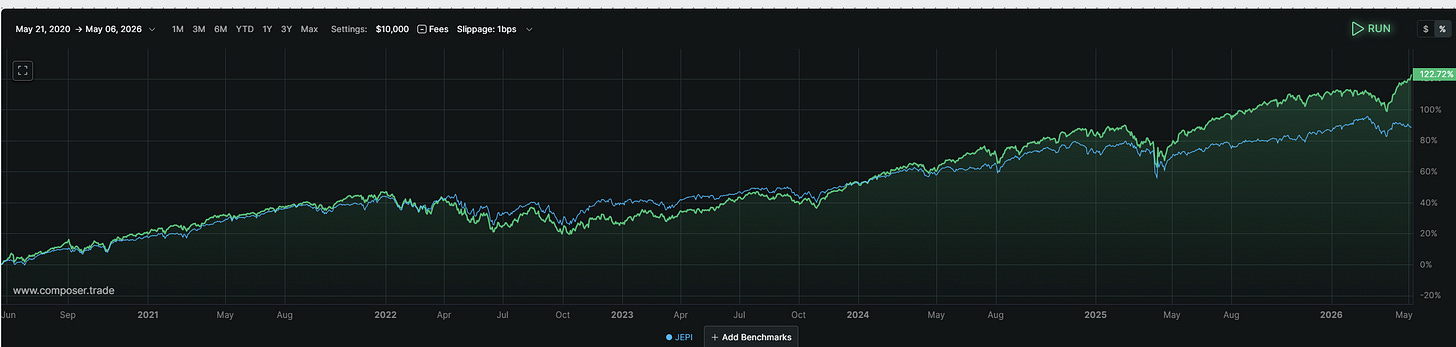
If curious here is 75% SPY vs JEPI since it launched:

The rally has people confused. What about the war? What about oil? What the f is happening in this chart:
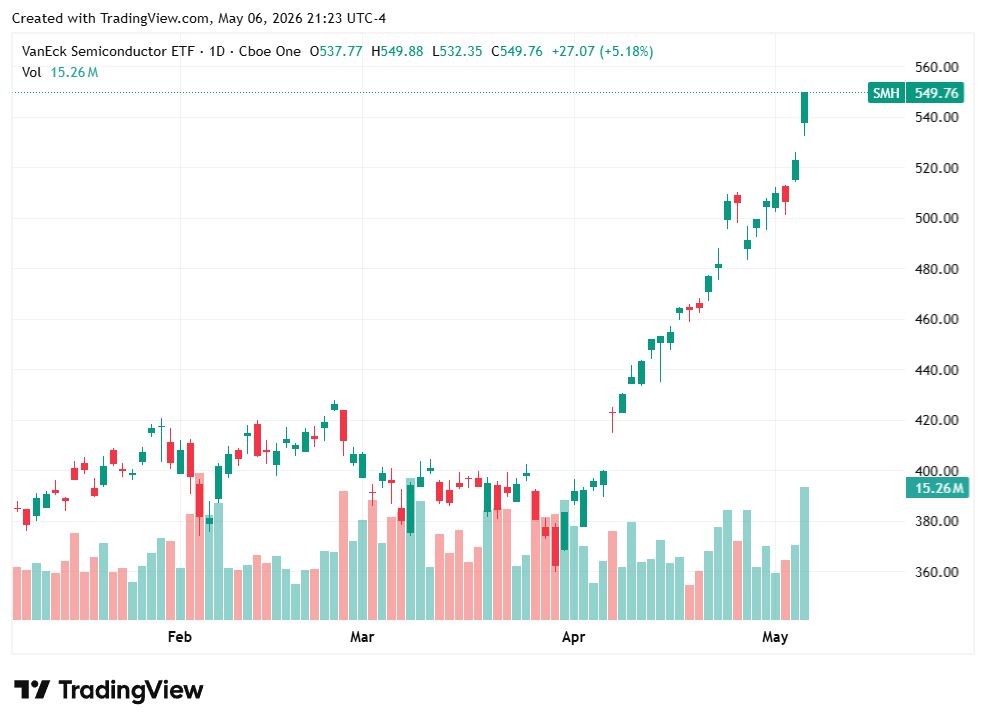
It’s not even a single stock. It’s a sector. A sector with a big market cap already!
Two thoughts wash over me.
Thought 1: Is any of the news we see reliable? Do we have perceptions that are unlinked to reality, causing the market behavior to look so dissonant?
Thought 2: Horse said it best and this was only 2 weeks into the up-flush:
If you need things to make absolute sense and be “logical”, you are going to have a tough time in markets.
— Horse (@TheFlowHorse) April 15, 2026
Let me save you some grief. Causality and stories are for historians, novelists, brand strategists, politicians, and grifters.
Traders are agnostic. Markets are Sudoku puzzles with prices in place of digits and risk/reward comes from the strain of contradiction. It can’t be otherwise. I saw Horse’s tweet after midnight when I couldn’t sleep so figured I’d pop off on why I agree.
Paradox of skill...the smarter markets are the more random it feels.
If lines to a game are well set you win some, you lose some and either way you pay the vig
The market not making “sense” ...makes sense
Your making money shouldn't depend on it making sense, because if it did, it would violate the idea that most people cannot make money trading (assuming the notion of sense was something shared)
This feels like some corollary to trading broadly...trading is about making money in the absence of knowing what is going to happen.
Trading is a practice that be adapted to any environment. Sometimes you inherit a departed trader's position. You deal with it. You manage the risk. Your ability to do this shouldn't depend on the market behaving according to your opinions.
I'm guessing that the needs-to-make-sense crowd sees the market like a physics or cause and effect problem rather than what it is. Positions and flows
(In the long run whatever that means it probably does make sense but nobody wants long run edge because it has long feedback loops and doesn't maximize throughput of an actual edge like higher turnover, better sharp strats. But short term movements have no reason to make sense in any economic or textbook ways)
The market is just positions and flows.
Why does it go up? There’s a lot of savings in America seeking a return and not enough issuance that it desires to satisfy it.
I’ll use the overrated phrase “first principles” to describe what I think of the market when I zoom out:
Laws and governance matter because they modulate the rights of managers to extract, influence, and enhance both the paid and retained claims that shareholders own. And then those rules and incentives determine capital allocations to generate returns that hopefully justify spending our cells’ ATPs on these projects instead of killing each other in a world of scarcity. This is all crucially important and their fulfillment or lack thereof will make sense in the story of humanity. But they operate on a different time scale than trading or short-term returns.
The only way the short-term stuff will make any sense is from the vantage point of knowing what people’s orders are. But the reason their orders are what they are will remain opaque (excluding of course, forced or recipe-based strategies — which is why arb-minded traders think a lot about what Euan calls “inefficiencies” as opposed to risk-premia.)
Implications
1) Specialize
In a finance context, this is what I call “matching your strategy to your dashboard”. Warren Buffet doesn’t do technical analysis to evaluate a business. The input of charts is not relevant to what determines his outcomes. Likewise, a trader focused on an opening range breakouts strategy doesn’t care about free cash flow. If you listen to traders and investors talk, listen for how things that wouldn’t be critical metrics in their dashboard seep into their thesis.
Remember the Paul Slovic study where experienced horse handicappers are given a few pieces of data of their own choosing. Armed with their preferred data, they are able to not only make good bets, but also to be well-calibrated about their accuracy. Their confidence and accuracy were in agreement. However, as the bettors are given increasing amounts of data their accuracy falls, but their confidence shoots up. No bueno. Presumably, they were less experienced in weighing the additional data, which turned it into noise for their handicapping process.
Just to broaden this section for a moment. With the success of David Epstein’s Range and the internet’s vague references to the “world belongs to generalists”, it’s probably contrarian to recommend specialization. The generalists get all the attention. Who doesn’t want to be the macro Neo seeing through the matrix of green digital rain to pull money out of connections nobody else sees?
It’s not just macro. VCs are seen as generalist extraordinaires studying up on a wide spectrum of technologies. Just enough to “be dangerous” as the self-aware ones will admit. But the trader in me doesn’t see a group of people with any special ability to see the future (painting with a broad brush, if you’re a VC reading this, you’re special, don’t worry). I see a social game with the goal to buy “below the bid”. The ability to buy in a dark market and sell in an efficient lit one requires specialization in something (probably marketing). And if you get that right, you have an edge. And that edge accumulates more advantage until you are free to tell any fancy story that sounds better than whatever their actual specialty is.
I’m not saying be one-dimensional. But becoming very pointy in a single area is a better beachead from which to launch the various campaigns in your life. Those may eventually lead you far away from where you started which is almost certainly a sign of victory.
The world actually belongs to the obsessed. Talk to parents. They know. The whole extracurriculars pu-pu platter is a fallback plan to Operation: Optionality because their kid has not found their obsession.
[Related thought: Being hot, super-charismatic, or any number of things we would think of more as a talent are all forms of speciality that can confound how we see the success of a “generalist”. But even then, there’s no ceiling for someone who applies their natural gifts to a craft that benefits directly from them. This is the dream. Talent and interest synchronously rowing in the same direction.]
2) Should you care about market plumbing?
I’ve seen this sentiment several times over the last couple years:
the transition towards the marginal players being increasingly risk/market/delta/beta neutral (ie just more fast-money shorting more different things and carrying more gross) feels like gross-up or gross-down is the new risk-on/risk-off and the high-correl moves are now long-tail https://t.co/clniIGfBjL
— the ghost of groditi’s future 👹 (@GRoditiD) May 6, 2026
The Seawolf guys (they were portrayed in The Big Short as the disagreeable investors in the weeds of bank accounting) have said something similar after a short tenure as pod PMs at Citadel. They said it’s important to understand how the pods move capital, even if they don’t think whatever they are doing is really investing. It’s more like trading with a focus on the coming quarter instead of intraday scalping.
If the pods are the marginal price setters, then understanding their behavior is important for traders or any investor whose investors judge them on the basis of months, not years. Nobody wants to be judged on the months of course, but not everyone can pick the investors best aligned with their horizon.
Speaking of horizons, if you care about short-run market behavior (days and weeks) but don’t have a dashboard tuned to flows, then day-to-day activity will remain inscrutable. If you care about intraday, then you are either in the same pool as HFTs OR you are staring for hours at illiquid order books to divine the story. Where can you compete?
Finally, these voodoo market movements can create opportunities for investors willing to underwrite a long-term thesis. This is admittedly tricky. Long-term investing is weirdly a difficult place for professional investors (it kinda feels like it’s a place that individual investors should have a better chance to prevail since they don’t answer to LPs, don’t need to benchmark, or worry about looking stupid).
Besides fickle LPs, professional long-term investors face feedback loops that can last a career, making them a) difficult to learn from and b) fertile landscapes for confirmation bias. Those types of edges are never provable. And when they exist, the horizon means less throughput…you aren’t getting thousands of at-bats to put the edge to work.
Insofar as a professional investor is able to convince investors to stay the course, this ability need not have anything to do with investing skill. In fact, a patient investor base paying an AUM fee is an arrangement that might make all but the most competitive investors a tad lazy.
The lack of feedback, throughput, and competitive pressures rooted in predictive performance metrics is a set of conditions that would not predict the best investors are looking to underwrite the long-run. This is a place to potentially compete. Of course, every silver lining has a cloud. Those near-term dislocations driven by the glorified day-traders might offer a better entry but the longer your holding period, the less your entry price matters. If you find a compounder for 15 years, it won’t matter much if you bought it for $80 instead of $100 because a bunch of pods got tapped to shed a factor.