become an option mixologist
All option structures are a version of 3 themes
To piggyback off David Epstein’s explanation of chunking, I've discussed the technique several times in my writing in the context of options. I use the chess player’s word for it (although I’m not a chess player): dissection.
These articles give concrete examples:
- Path, VIX, & Hit Rates vs Expectancy
- the right bogey: trades that seem compelling but aren’t and vice versa
The second one links to a video where you can follow along on an example.
At first, you consciously look for groups or patterns that compress a theme, but with practice this becomes automatic. You can't help but see the pattern.
Like the sports examples, an experienced trader will be able to pull the trigger faster than slavish processing would allow. The shortcuts become part of their wiring. You could see this in an open outcry trading pit or even amongst the best mock trading students back in the old floor days. That ability to say “sold” or “buy’em” faster than a large group of competitive traders because you saw the arb line up is happening at a subconcious pattern level. You make the trade and working out the particulars of the “why” while the instructor is still in the act of halting the the class to ask why you made the trade. I don’t know how it works but my pop science guess is that your synapses which have been strenghtened along specific pathways are a step ahead of your explicit reasoning.
Dissection is a deliberate form of “chunking”. But if we zoom out a ring from the specifics of option structures to the parameters they express, there are only 3 we generally care about: volatility (or variance), skew, kurtosis. In stats terms, these map to the 2nd, 3rd, and 4th statistical moments of the distribution.
There’s a vanna-vega-volga model sometimes referred to as “the cost of gammas” framework which actually formalizes this idea by mapping the parameters to their costs.
Volatility is represented by the cost of the straddle.
Skew is represented by the cost of a risk reversal.
Kurtosis is represented by the cost of a strangle.
These map to pertinent Greeks as well:
straddle → vega
RR → vanna
strangle → volga
You pay IV premiums for all of these convexities. Vol risk premia for the straddle, you pay skew premiums for the ability to be long spot-vol correlation in the direction for which IV tends to rise as the market moves (so in SPY you pay a premium for the puts but in oil today you pay a premium for the calls), and finally, for volga, or “vol gamma” you pay an IV premium for wingy options.
To a beginner, the zoo of option structures is overwhelming. Seriously look at this page, the screenshot is only part of what I could capture:
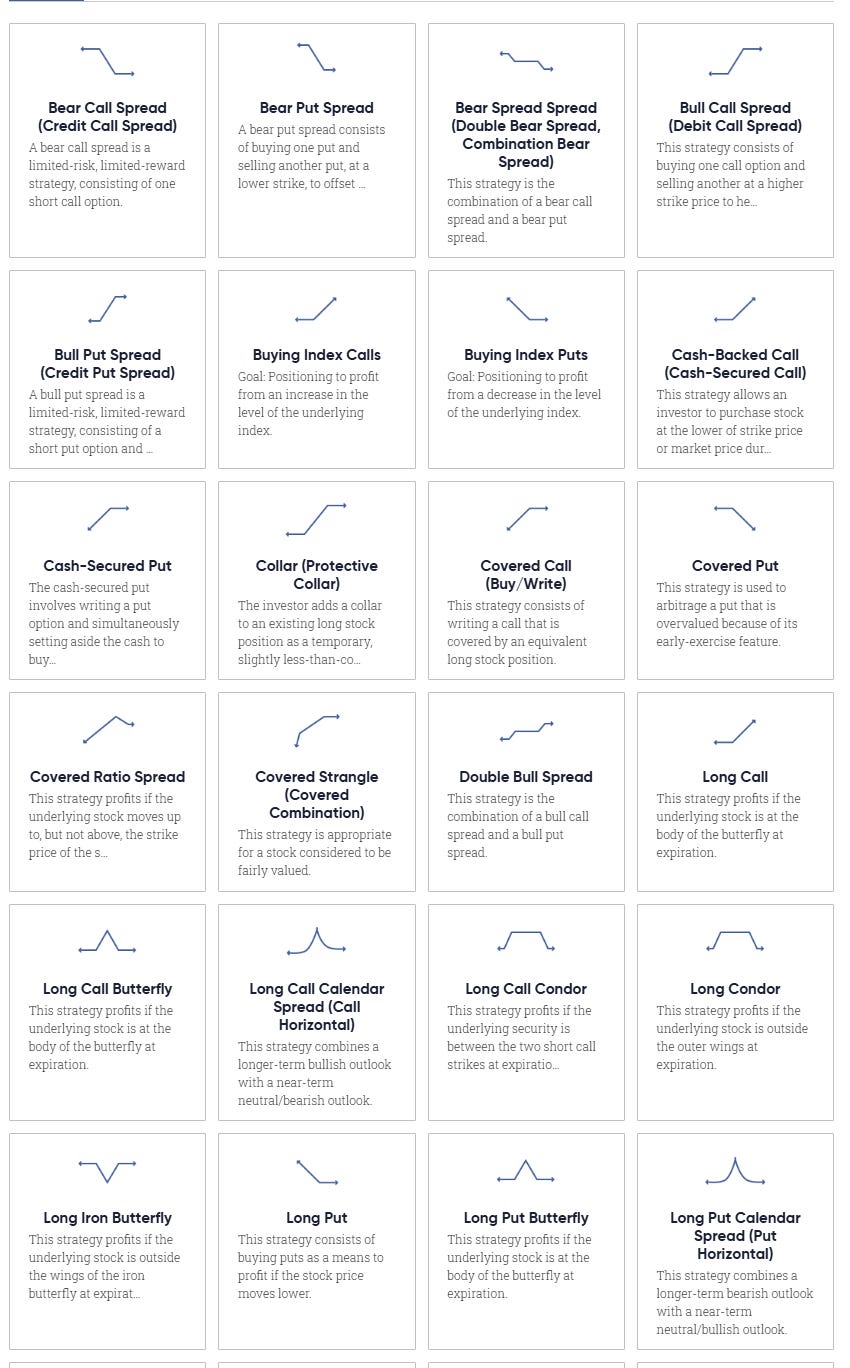
It doesn’t even cover them all. There’s still jelly rolls, Christmas trees, rev/cons, diagonals, strips, “stupids”. I’m not kidding on that last one (it’s buying or selling a package of options in the same maturity but different strikes, so buying both the 700 and 650 puts as opposed to spreading them).
But if you understand that there are only 3 parameters we care about, then all of this collapses into a few themes. There’s a million different types of cocktails, but according to the mixologists at Death & Co there’s just key elements to the drink:
- alcohol (base)
- sugar (sweetener)
- acid (brightener)
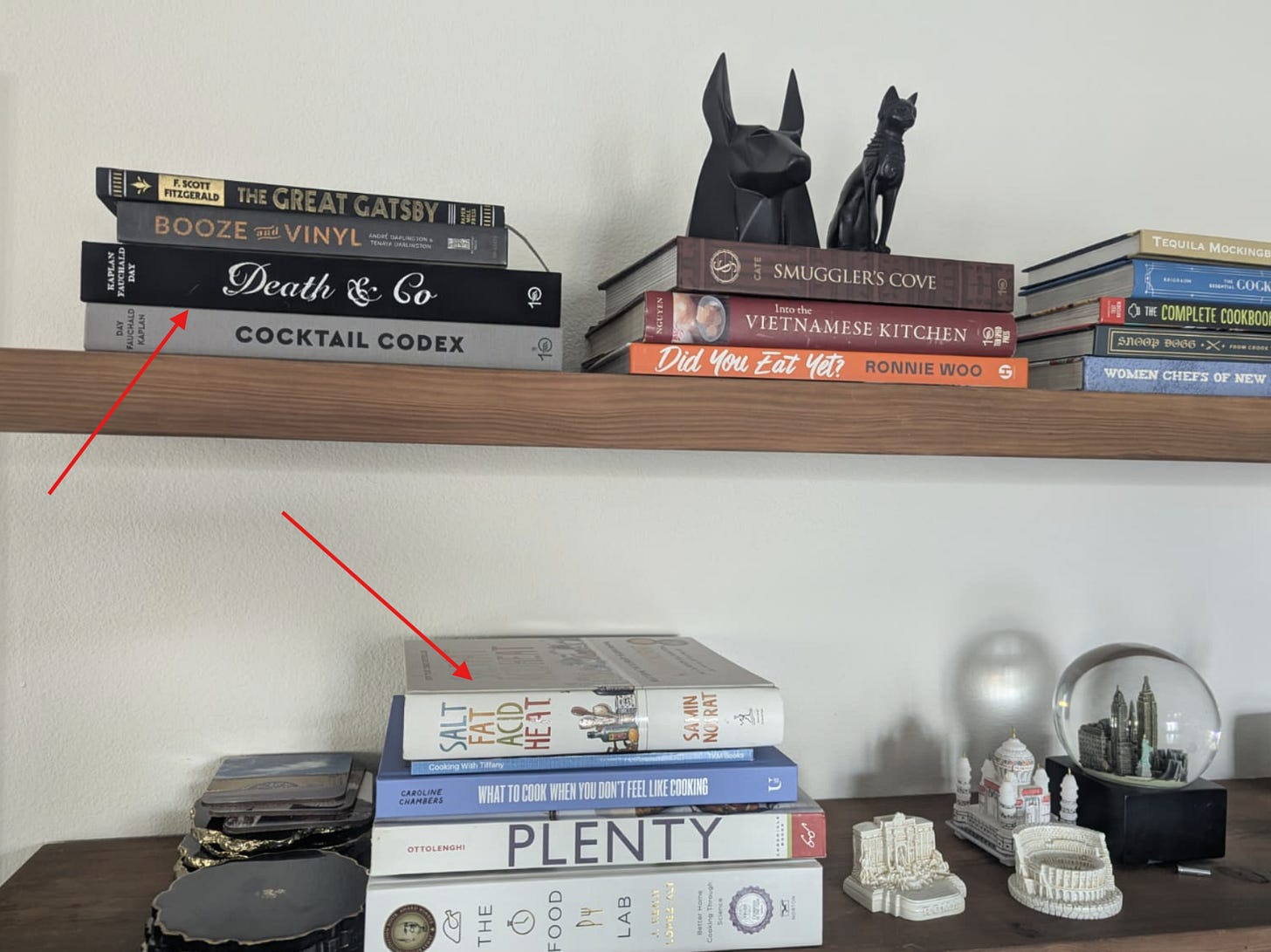
If you prefer the cooking analogy, it’s salt, fat, acid, heat.
All recipes, whether in options, cuisine, music (there are thousands of chords but you can collapse to major/minor modified by dominant, sus, and add9) can be reduced to a few themes.
How does this help?
I’ll give you an example from our Discord this week.
Someone asked:
Anyone got any ideas for screening for good call spreads or put spreads to buy systematically in a potentially semi-automated way using moontower. A lot of the guidance I've read is 'if you have a directional view'... well umm, I'm a ding dong with no directional ideas want something algorithmic.
I’m also a ding-dong, I just happen to understand that the price of option structures derives from the cost of our 3 friends: volatility, skew, and kurtosis.
This was my response:
What makes a vertical or debit spread generally cheap?
Low IV and high skew at the strike you are selling. So relatively cheap ATM/.25d call spread will have low IV and high call skew.
A relatively cheap OTM call spread could come from the IV being relatively low and the .25d call skew being low if that’s the long leg of the spread.
So here are a few suggestions...
- Sort for low IV percentile and high call skew for ATM to .25d call spreads or
- Sort for low IV percentile and low call skew if you want to buy an OTM call spread, meaning your buy leg is say .25d
- Use our Trade Ideas tab to look at names that score well on “Buy Vol” and then also sort by call skew in the table below!
You can also talk to the agent about building a prompt for this and then make it an Automation.
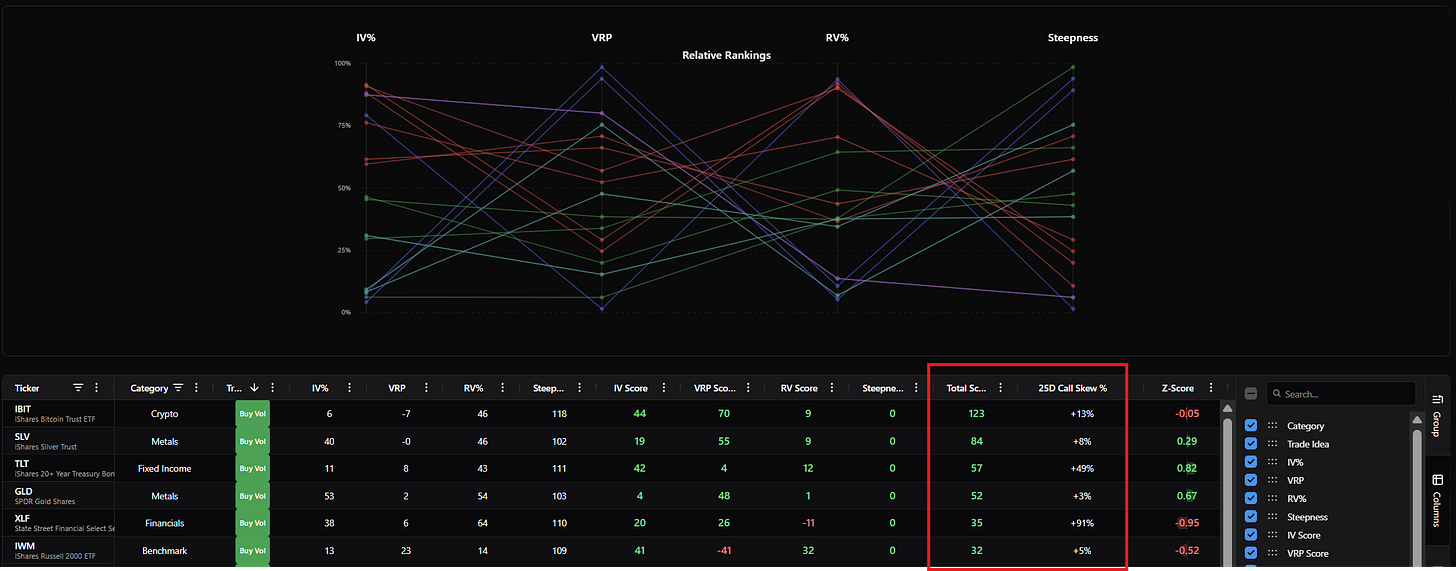
Our Trade Ideas algo scores names based on how they stack up to various preset trade themes (ie “buy vol”, “sell vol”, “long calendar”) according to their parameters and what signatures we look for. You simply add the column for 25d call skew which tells you the percentile, and using the logic from my answer, find names where the parameters present attractive spreads.
You had to understand that the price of the option structures map to these 3 themes in the first place and suddenly the zoo of possible option trades is massively reduced in dimensionality. It’s the progression from option bartender at your college party to option mixologist where you understand that all drinks are just a few flavors.
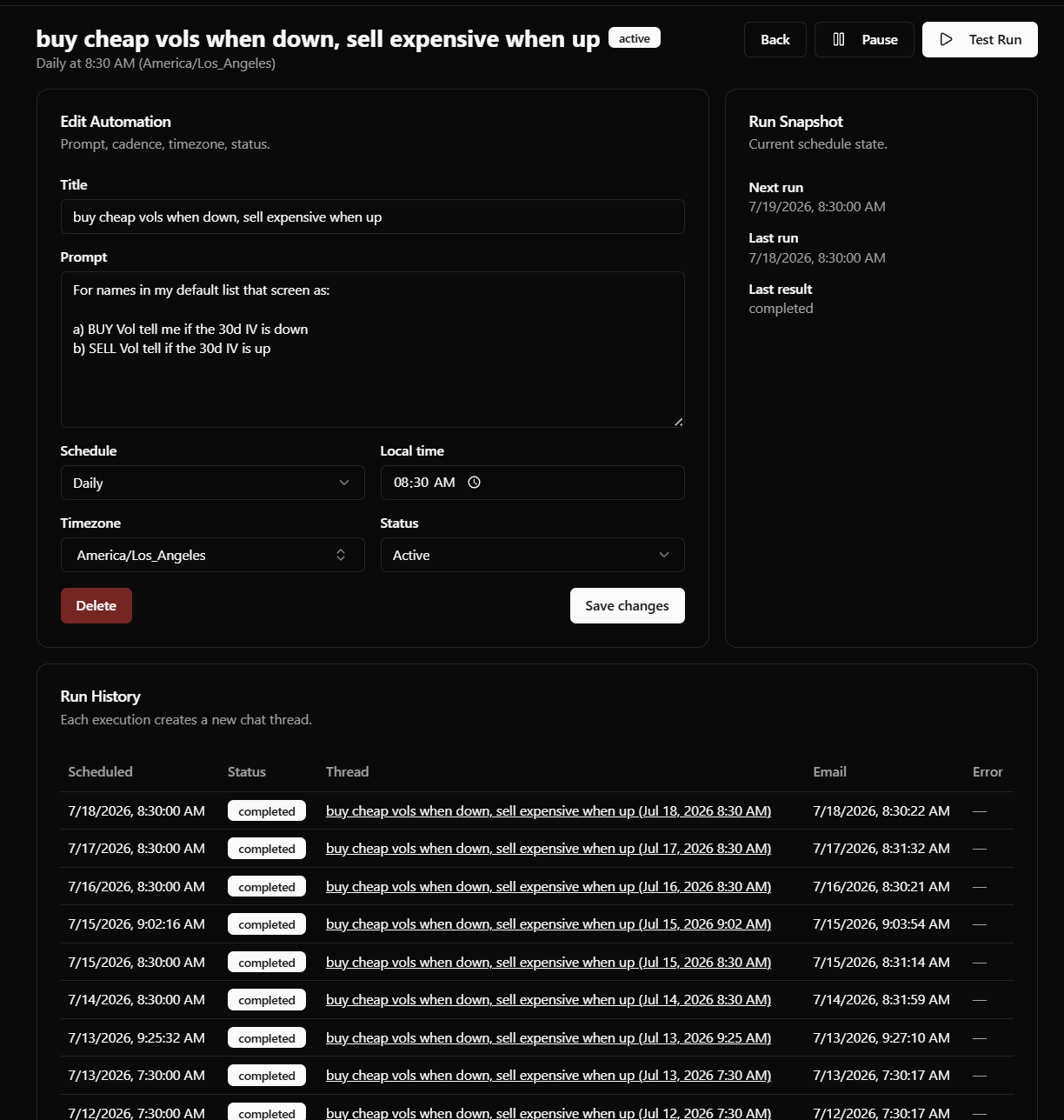
And just to address the Automations thing, we have a new feature in our tool. An example of one of mine where the agent emails me on a schedule when a name with a strong “Buy Vol” score’s strike vols are down and vice versa: