
futures premium cell
Futures lead the cash
Back in my SIG days, every trader had a cell on their spreadsheet showing the SPUs (the name for SPX futures back in the day; it’s derived from the September symbol) premium or discount to the “cash”.
A little background
The cash is the SPX index price based on its components’ spot prices. You can compute the index value from the stock bids, and that would be the “SPX cash bid”. You can do this for the offer as well. The average of the bid and offer is SPX mid-market.
Futures contracts, based on no-arbitrage pricing, have a fair value based on what you gain or give up by owning the future instead of the cash basket. Since you save the interest on the cash it would cost to own the basket but forgo any dividends you would have received that offset the drop in the shares when they are paid the futures are valued as
SPX + (interest - dividends)
The interest and dividends are estimated from today until the futures’ expiry date.
Assume:
SPX cash mid market: 7,800
RFR = 3.5%
annual dividend yield =1.5%
t = 1 year
The 1-year future fair value is approximately 7800e(3.5% - 1.5%)*1 = 7957.57
The basis between the future and the cash index was known as the EFP (“exchange for physical”). In our example, it equals 157.57
If the future was trading 7977.57, we’d say “the futures are trading over”. In this case, it would be 20 points or about 25 bps rich as a percent of the cash index.
This is an arbitrageable difference as a trading firm can sell the future, buy all the components, and book a theoretical profit that will become a real profit if their carry assumptions hold true. As a market-maker on the floor, I was not involved in index arbitrage this directly (although most of my clerking experience was much closer to these strategies).
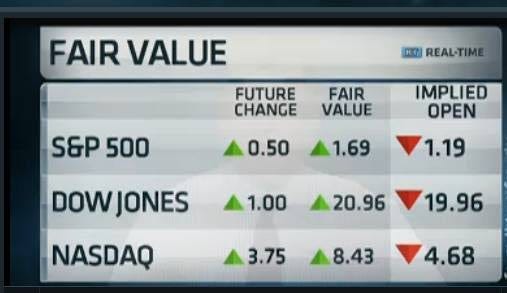
The futures are more liquid than the cash index so the basket price lags. If systematic bullish news hits the tape, you cross the tiny bid/ask on the futures. In fact, the ES or e-mini future actually leads the big SPUs, so ES was used for computing the premium or discount.
All of the market-makers had a cell on the spreadsheet on their handheld tablets that showed the futures’ premium/discount to fair value (FV = cash index + EFP). Those premiums or discounts were typically small, 10 bps or less, as the market bounced around. But huge news could catapult the futures 300 bps before much of the basket could blink. As you can imagine, index arbs get very uneven fills on the baskets they try to execute to close the gap. That’s because everyone making markets has not only pulled their stock offers, but lifting resting customer offers, often several levels through the NBBO that was posted a split second ago.
You can beta-weight the “amount over” or premium the futures are trading to estimate a new fair value for the stock. If the stock you trade has a 1.2 beta, then you might think its new fair value is 3.6% higher than the pre-news price if the futures are trading at a 3% premium. Of course, beta is just a statistical quantity so you have a confidence interval around the beta, which is pretty much life as a market maker. Futures are trading 300 bps over, what’s your 2-way on XYZ stock? Maybe I’m “2% over” bid, offered “4% over”. Then, you’d need to be quick to remember what bids and offers on the option chain are resting that you should race to lift (all the calls should increase by their delta * your beta-weighted change in fair value) and hit (all the puts will decrease by the same factor and this is not even considering the effect of gamma).
Today, all the quotes being streamed by traders will get pulled while they simultaneously blast all the resting orders in a flash, but this process happened a bit more at human speed 30 years ago (although you still weren’t gonna beat the floor...the competition for the resting orders would be market-maker on market-maker).
I’m mostly sharing this because it’s fun for the stragglers who read this far into the masochists section, but it’s worth mentioning the context that made me think of it.
This phenomenon sometimes leads to anti-data or an interpretation of data that is exactly the opposite of the typical inference.
Why?
If a contract or security trades on the offer, the assumption is generally that “paper” (trader language for customers) is buying and the market-maker is selling. But in the example above, the market-makers are the aggressors because they know the market is much higher than last sale. They are lifting calls and hitting puts, so your read on flow sentiment is exactly the opposite of a normal market condition.
Just another example of reality having a surprising amount of detail.